
Fine-Grain Audiometry
Tinnitogram™
A microscope for your hearing.
A routine hearing test samples eight frequency bands. Tinnitogram measures hearing thresholds across 67 frequency bands. With more than 8x the level of detail, providers are able to identify tinnitus markers with greater accuracy.
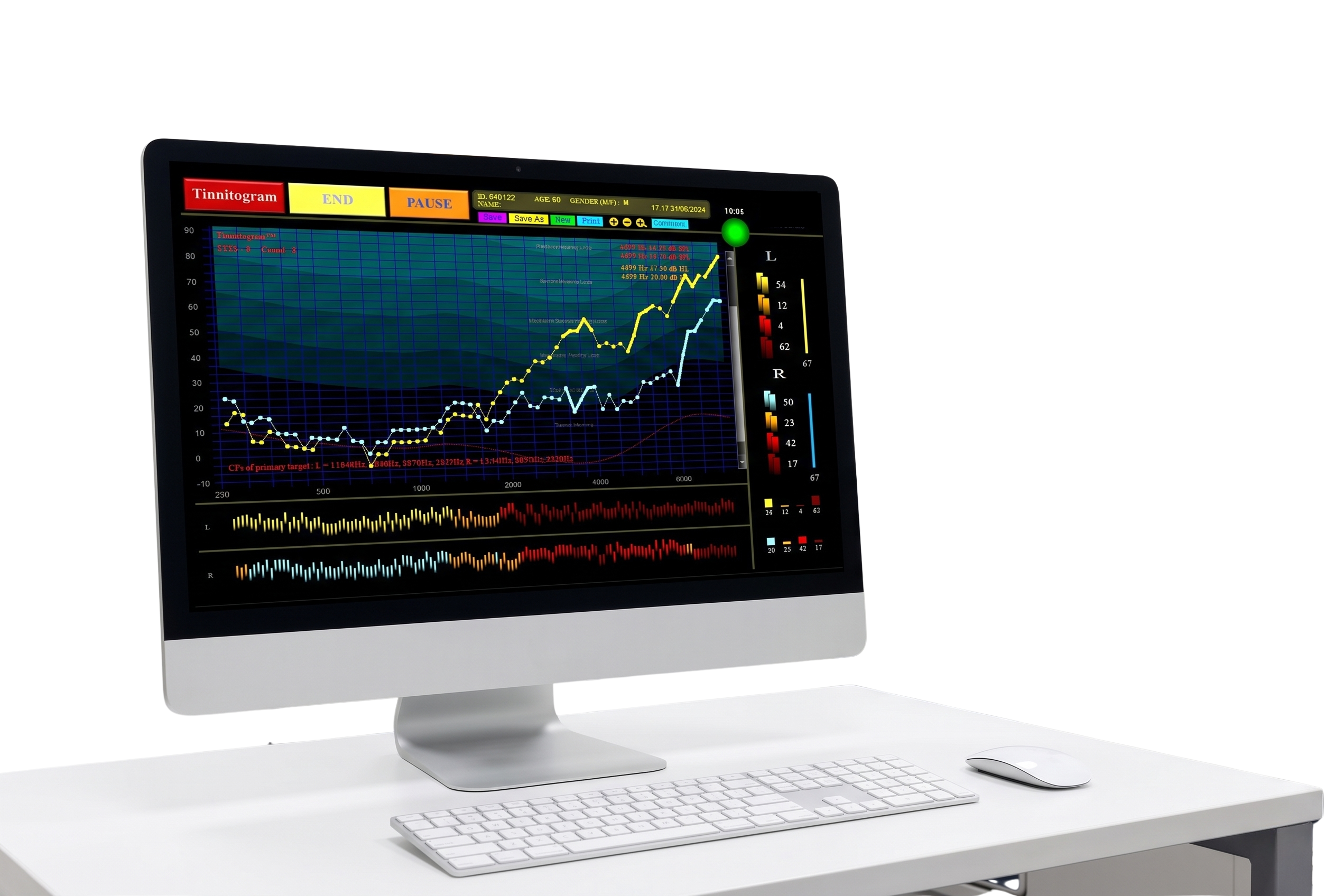
Tinnitogram on a clinic monitor showing the 67-band threshold view. Slightly off-axis, shallow depth of field.
Frequency bands measured per ear.
Hertz covered, including the high frequencies routine tests stop short of
Americans seek medical care for tinnitus each year
A microscope
for your hearing.
Tinnitus rarely announces itself across a whole octave. It tends to sit in a narrow region, sometimes a single notch a few hundred hertz wide. An eight-point test can pass straight over it, which is how a patient ends up being told their hearing is normal while the ringing continues.
Move across the chart
- Measured by Tinnitogram
- Sampled by a routine 8-frequency audiogram
Illustrative example. Not patient data.
Routine audiometry
8
250 to 8,000 Hz
Tinnitogram
67
262 to 11,840 Hz
Three things a standard
hearing test can miss.
The limitations that Tinnitogram overcomes.
Narrow notches
Loss between the test points
A dip in sensitivity that sits between two standard test frequencies is invisible to an eight-point test. At 67 bands it appears as what it is: a localized, measurable notch.
Extended high frequency
The range above 8 kHz
Routine audiometry usually stops at 8,000 Hz. Tinnitogram continues to 11,840 Hz, where early noise-related and age-related change often shows up first.
Tinnitus markers
How tinnitus maps to hearing
Mapping thresholds at fine resolution lets you see how a patient's tinnitus relates to their unique hearing profile, rather than inferring it from a handful of points.
How Tinnitogram works.
Tinnitogram is administered by a hearing care professional and fits the appointment structure a practice already uses.
Set up Tinnitogram
The patient is seated with calibrated transducers in a quiet test environment. Because the measurement is threshold-level, the same transducers are used consistently across visits so results stay comparable.
Measure 67 bands per ear
Similar to a standard hearing test, patients respond to randomized tones. Tones are played automatically, not requiring manual initiation of tones. Each ear is measured independently, because tinnitus is frequently asymmetric.
Review the profile together
The result is a high-resolution threshold curve. It is a genuinely useful thing to show a patient, because it makes their experience legible. Most patients have never seen their hearing described at this resolution.
Identify the target frequencies
From the profile, the center frequencies that will be targeted by therapy are identified. Those values are what REVE134™ uses to build the sound therapy plan.

Patient in the booth with insert earphones, audiologist at the console in soft focus. Calm, unhurried, looks like a real appointment.
Tinnitogram is fitted and administered by a hearing care professional.
A more precise measurement
for more precise
tinnitus therapy.
Your Tinnitogram is just the start. It is the input that makes precise calibration possible, and it is repeated through the course of therapy so the plan can be retuned against a current measurement rather than the original one.
How REVE134 uses this dataCommon
Questions
No. It sits alongside the standard diagnostic workup rather than replacing it. A conventional audiogram remains the basis of clinical hearing assessment. Tinnitogram adds resolution in service of one specific job, which is identifying the frequency regions that precision sound therapy will target.
A Tinnitogram evaluation takes approximately 15 minutes.
A quiet test environment and calibrated transducers. The important operational detail is consistency: the same transducers should be used for a patient's baseline and every follow-up, because threshold-level measurement is sensitive to the transducer used. Contact us and we will confirm compatibility with what you already have.
The range is set to cover the region where tinnitus percepts and the associated threshold changes are most commonly found, including the extended high frequencies above the 8,000 Hz ceiling of routine audiometry. The 67 bands are distributed across that range at a resolution fine enough to resolve narrow notches.
Yes. Re-measuring is what allows the therapy plan to be retuned rather than left static. It also gives you and the patient an objective reference point at each review instead of relying only on self-report.
Add fine-grain audiometry to your practice.
Tell us about your setup and we will walk you through what integration looks like, including training and support.