
Therapy Calibration
REVE134™
Precision Sound Therapy Calibration.
Tinnitogram™ establishes where tinnitus may be stemming from. REVE134 gives you the tools to target it. The result is a personalized, Precision Sound Therapy that's reduced below the audible level and delivered through standard earbuds. A non-invasive, effective combination of at-home therapy with clinically supported care throughout.
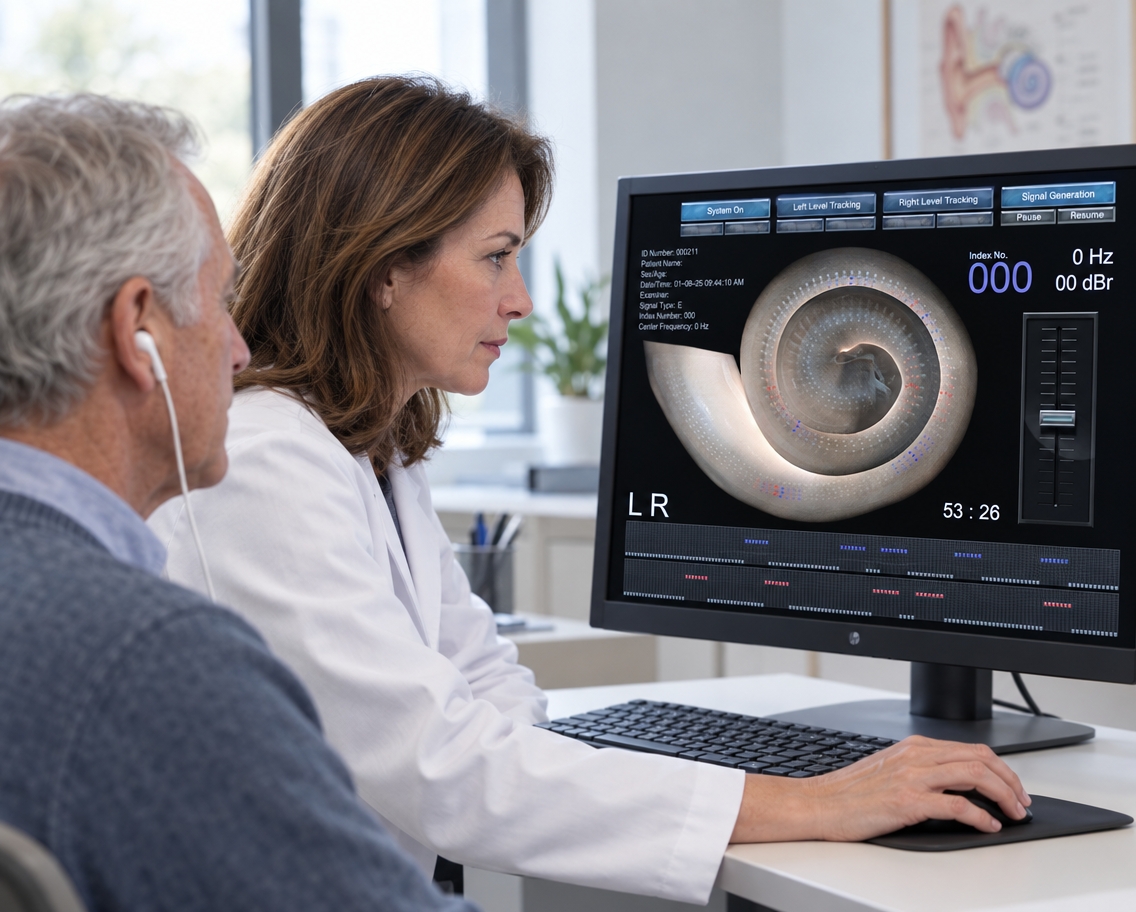
REVE134 calibration interface on a clinic monitor with the cochlear frequency visualization on screen.
Precise calibration to stimulate tinnitus markers.
Two patients can have tinnitus that sounds identical when they describe it and require completely different signals. The frequencies differ. The thresholds at those frequencies differ. REVE134 was created to personalize each patients' plan to their unique hearing profile. Not a one-size-fits-all approach.
Input
Personalized to Tinnitogram results
Takes the 67-band threshold profile and the target center frequencies identified during measurement, per ear.
Level
Finds the softest detectable level
Establishes, at each target frequency, the quietest level the patient can still detect. That value sets the amplitude of the signal.
Output
Generates the sound file
Produces the personalized audio the patient will use, calibrated to the earbuds they are given so the level holds true in daily use.
Tinnitus therapy that’s quiet enough to stick with.
Most sound-based approaches to tinnitus work by being heard. This one works by barely being heard. The signal is set at the edge of detectability, which is what makes an hour a day tolerable rather than a chore, and what lets a patient wear it while working, reading or cooking.
60 dB
30 dB
20 dB
Threshold
Illustrative comparison, not a specification. Reference levels are approximate everyday examples. The therapy signal is set individually, at each target frequency, from the patient's own measured threshold, so there is no single decibel figure that describes it.
Therapy optimization
is essential.
If thresholds change during therapy, a signal calibrated against the original measurement is no longer calibrated. That is why the sequence repeats. Each cycle starts with a fresh Tinnitogram and a newly generated file, so each patient's therapy evolves with them for greater efficacy.
Cycle one
Day 0Baseline measurement, first calibration, first sound file. The patient leaves with calibrated earbuds and a daily routine.
Cycle two
Day 30Re-measure, review against baseline, generate a more finely tuned file from the current profile.
Cycle three
Day 60Re-measure again and produce the third file. This is the one most patients continue with afterward.
Course complete
Day 90Twelve weeks of consistent daily use across three calibrations, with measurement at every step.

The handover moment. Audiologist passing the patient their calibrated earbuds. Hands and device in focus, faces soft.
An audio player, headphones,
and a real plan for relief.
- Their own sound file. Generated from their measurements, for their ears, not selected from a library of presets.
- Calibrated earbuds. Level accuracy depends on the transducer, so the earbuds are part of the calibration rather than an accessory. Substituting a different pair changes the delivered level.
- A daily target. At least sixty minutes a day, at a level they will mostly not notice, while doing something else.
- A review date. A follow-up already booked, because the plan is built to be re-measured.
Questions
we get.
They do not, in the moment, and that expectation needs setting at the first appointment. There is no sensation of relief when the file starts playing. What patients notice, if they notice something, develops over weeks. The objective reference is the re-measurement at each cycle, which is one of the reasons measurement is built into the protocol rather than optional.
REVE134 is sound generating software cleared by the FDA for use in a tinnitus care program, to provide temporary relief for people experiencing tinnitus symptoms. It is worth being precise about what that means: clearance covers the device and its indication for temporary relief. It is not a finding about long-term outcomes, and it is not the same thing as the clinical evidence for threshold sound conditioning, which we discuss separately and candidly.
For the evidence base and its limits, see our page on threshold sound conditioning.
No, and this is the single most common way a course goes wrong. The calibration is specific to the transducer used. Different earbuds have different output for the same file, so swapping them changes the delivered level and undoes the precision the calibration was for. Patients should be told this plainly, more than once.
Consistency is the variable most under the patient's control, and the protocol is built around daily use over twelve weeks. Occasional missed days are a practical reality rather than a failure. A pattern of missed days is worth discussing at review, because it changes how you interpret the re-measurement.
Yes. Each cycle produces a new file generated from a fresh measurement. Patients use three different files over the course of therapy, one per thirty-day cycle, and most continue with the final one afterward.
See a calibration end to end.
We will walk your team through a full measurement and calibration on a live system, using your own setup.